
Title deeds and the land register: what you need to know before buying property in Istria
 by Adriatico Real Estate

Buying a property is always a big step, no matter how many times you have done it, so it is worth taking certain preparatory steps to make the process as simple as possible.
One of the first steps is getting to know the Uređena zemlja system (https://oss.uredjenazemlja.hr/public-services/review-lr-bdc), where you can check the title deed of any property in Croatia and immediately learn the legal status of the property you are interested in.
How do you use the “Uređena zemlja” system?
To use the “Uređena zemlja” system, you first need the following information: the cadastral parcel and the cadastral municipality.

The cadastral municipality is entered in the “Glavna knjiga” (main book) field; there is no need to fill in the “ZK odjel/Općinski sud” (land registry department/municipal court) field before it.
Once you have selected the correct cadastral municipality, enter the exact parcel number in the “Broj katastarske čestice” (cadastral parcel number) field and click “Neslužbeni izvadak” (unofficial extract) to get the land registry extract for your property.
What is a land registry extract and why is it important?
A land registry extract is a public document that contains all the essential information about a property. It is extremely important because, legally speaking, whatever is entered in the land register is presumed to be true and to fully reflect the factual and legal status of the property. A buyer who acted in good faith, relying on the land register, is therefore legally protected if they did not know, and in the circumstances had no sufficient reason to suspect, that what was registered was incomplete or differed from the actual situation outside the register. Lack of good faith cannot be held against anyone merely because they did not investigate the situation outside the register.
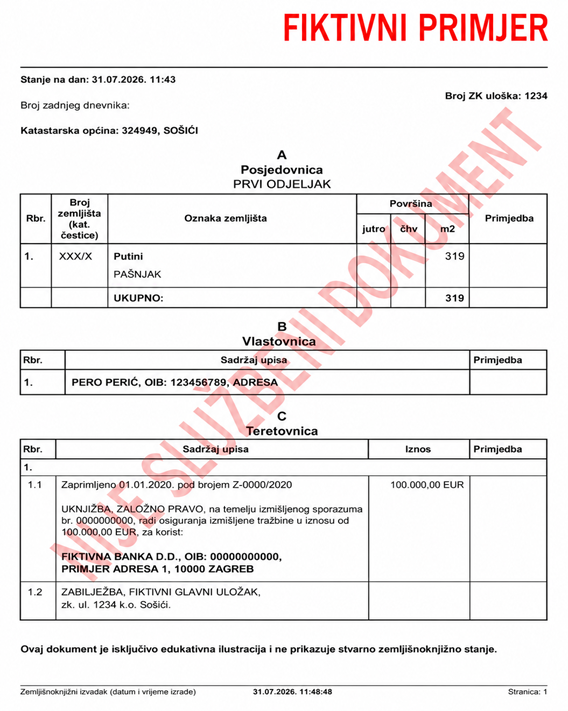
A land registry extract consists of 3 parts, which together contain all the information about the property that you need to know.
Possession sheet (Posjedovnica) – basic data and characteristics of the property
The possession sheet, or sheet A of the land registry extract, contains data on the properties that make up the land registry entry. It lists the cadastral parcel number, its name, area, type of use and whether it is built on, as well as the real rights established in favour of that entry. All changes to this data are recorded too, for example a change of parcel number, area or type of land use. Special public-law restrictions affecting the legal transfer of the property may also be entered in the possession sheet, including the fact that no location, building or use permit has been issued for a building.
It is important to note that a property described as arable land, meadow or similar is not necessarily non-building land, so your agent will provide you with further documentation that determines the permitted land use in more detail.
Ownership sheet (Vlastovnica) – data on the ownership of the property
The ownership sheet, or sheet B, contains data on the holders of ownership rights over the entire land registry entry or over a separate part of it, where condominium ownership has been established. This section records the owner of the property, their co-ownership share and all subsequent changes of ownership. Personal restrictions on the owner’s ability to dispose of the property are also entered here, for example the fact that the owner is a minor or that bankruptcy proceedings have been opened against them.
With the ownership sheet, it is important first to establish whether the person presenting themselves as the seller is also registered as the owner of the property and, if not, whether they hold a power of attorney from the registered owner. If the subject of the sale is, for example, an apartment in a building, the ownership sheet also shows whether the building has been divided into condominium units or whether the apartment is being sold as one of several co-ownership shares.
Encumbrance sheet (Teretovnica) – rights and encumbrances on the property
The encumbrance sheet, or sheet C, shows the rights of third parties and other encumbrances on the property. From it you can see whether the property is burdened by a mortgage, an easement, a building right or another real right. Certain contractual rights, such as rights of repurchase, pre-emption, lease and tenancy, may also be entered here. This section also records concessions on public property and notes of legally relevant proceedings and circumstances, such as enforcement or a dispute concerning the property.
In the encumbrance sheet, the most important thing is to see whether any encumbrances are registered that would restrict the disposal of the property. The most significant are, for example, entries of various prohibitions on disposal, entries showing that proceedings are under way in relation to the property, or a mortgage registered on the property. None of these entries necessarily prevents the conclusion of a sale contract, and your agent must inform you of the status of such entries and how they could be removed.
With this article we have tried to make this very important part of the purchase process easier to understand, so that you can judge for yourself whether you have been given accurate information about the property you want to buy.
If you want certainty in the purchase process and someone to guide you through the entire procedure, your Adriatico Real Estate team is at your disposal!


